
PRODUCT WALKTHROUGH
See the evidence trail behind every RelyCare draft.
RelyCare turns session audio into a review-ready SOAP note draft while keeping targets, first attempts, retries, cueing, errors, self-corrections, and supporting transcript quotes available for clinician review.
How It Works
From session audio to an evidence-linked clinical draft.
01
Capture the session once.
RelyCare creates a speaker-labeled transcript and preserves literal, audibly demonstrated session details for the clinician to inspect. Clinically relevant errors, disfluencies, approximations, and corrections should remain visible instead of being polished into a generic conversation summary.
02
Inspect the evidence trail.
Target metrics, first attempts, retries, cueing, errors, self-corrections, and representative quotes remain connected to the draft. The link helps the reviewer find what supports an observation, challenge the scoring basis, and correct anything the recording or analysis missed.
03
Edit and approve the SOAP note.
The clinician reviews Subjective, Objective, Assessment, and Plan, corrects the record when needed, adds information that was not audible, and approves the final documentation. RelyCare does not sign the record or turn a fluent draft into an external clinical validation.
04
Carry finalized context forward.
Finalized records can feed the patient timeline for longitudinal review when enough comparable history exists. The clinician interprets any proposed trajectory; the software does not declare mastery or discharge readiness. Raw session audio is deleted after finalization.
Platform Preview
Product surfaces tied to the clinical workflow.
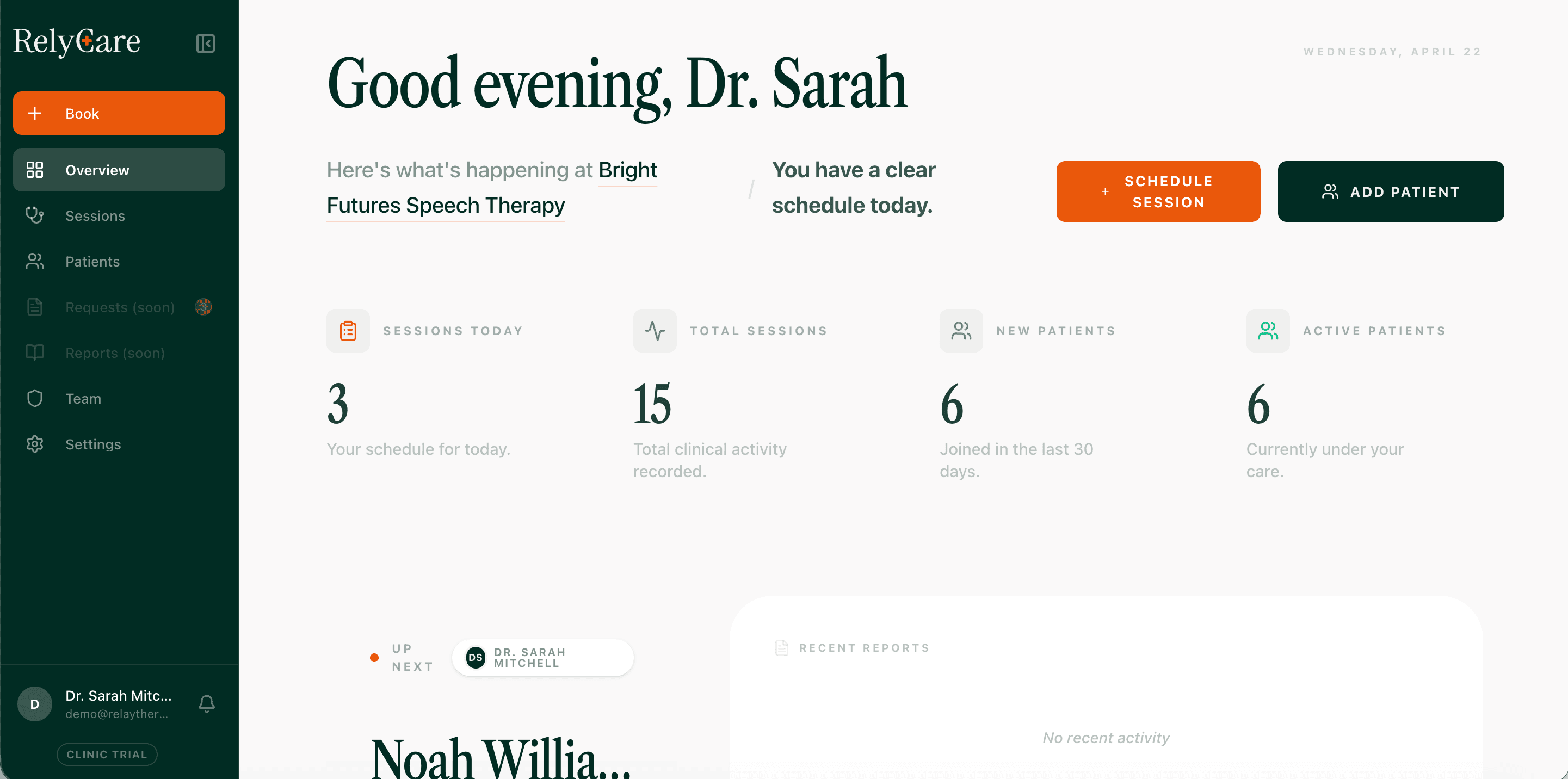
Clinic dashboard and documentation queue
Composite demo · transcript excerpt
Speaker-labeled transcript
Composite demo · observation
Structured observation
Composite demo · target performance
Initial /s/ · word level
8 / 17
First-attempt scoring · 47%
7 successful cued retries · 2 self-corrections · verify against transcript
First-attempt metric
Composite demo · representative evidence
Mason: “Thun.” → after verbal cue: “Sun.”
Linked to transcript for clinician review
Supporting quote
Composite demo · SOAP draft
Mason produced initial /s/ accurately on 8/17 first attempts (47%) at word level. Seven documented retries were accurate following a verbal cue, and two responses were self-corrected before another cue.
Clinician review requiredSOAP draft for review
Composite demo · finalized-session context
Baseline
47%
Session 2
80%
Session 3
81%
Invented, non-patient example for workflow demonstration—not an automatic mastery decision.
Finalized-session context
This is a composite workflow demonstration using invented, non-patient data. It shows how the artifacts connect; it is not a clinical accuracy or outcome claim.
Built For
For SLPs who need more than a generic transcript summary.
SLP-Specific Session Detail
RelyCare is organized around operational targets, task context, first attempts, supported retries, self-corrections, cue levels, error patterns, representative stimuli, and transcript quotes. Those details are available when they are audible or verbally reported; visual behavior and unspoken clinical context still belong to the treating clinician.
Inspectable SOAP Drafts
The goal is not a note that sounds confident. It is a draft whose important observations and metrics can be inspected before approval. Clinicians can review the transcript context, correct speaker attribution, verify the numerator and denominator, change the interpretation, and decide what belongs in the final record.
Assessment and Report Workflows
Recorded assessment context can support structured drafts containing test information, scores supplied during the workflow, language-sample observations, interpretation, goals, and medical-necessity language. These remain drafts: the qualified clinician verifies source data, supplies missing examination findings, and approves the report.
Longitudinal Patient Context
Finalized sessions can contribute to a patient trajectory after enough comparable history exists. RelyCare keeps task and cueing context available so the SLP can judge whether a comparison is meaningful. It does not automatically decide mastery, regression, treatment changes, or discharge readiness.
Session Planning and Carryover
The reviewed clinical record can inform a later session plan, caregiver summary, or home-practice draft. The clinician chooses the goal, level, materials, success criteria, and communication that fit the patient. Parent-facing content is reviewed and approved before it is sent through a connected workflow.
Clinic Review and Handoffs
Solo therapists and growing teams can keep documentation queues, finalized patient context, and follow-up work inside one speech-therapy-specific system. That does not remove governance: clinics still define roles, consent, access, record retention, review responsibilities, and where approved output belongs in existing systems.
Privacy-Conscious Pilots
Raw session audio is a temporary processing artifact and is deleted after finalization. A BAA is available for eligible HIPAA-regulated clinics under the required contractual and operational conditions. US and South African clinics should confirm their own consent, privacy, device, retention, and professional obligations before real-session use.
A Review Process You Can Challenge
A useful AI documentation workflow makes uncertainty inspectable. During review, the SLP should be able to ask whether the correct speaker was identified, whether an attempt was scored under the intended rule, whether a retry was mistaken for an independent success, and whether the quoted context actually supports the draft. RelyCare keeps the source trail close enough for those questions to be practical before the note becomes part of the clinical record.
Clear Limits on What Audio Can Establish
Session audio can preserve speech, language, cueing, verbal reports, and other audible context. It cannot independently establish posture, facial expression, eye contact, device use, written performance, or an unspoken clinical observation. RelyCare leaves room for the treating clinician to add those details, correct ambiguity, and exclude content that the recording does not justify. The finished note is the clinician's reviewed record—not a claim that the model witnessed the whole session.
Continue Exploring